FCIP 2026: My Highlights from the 26th Festival of Israeli Cinema in Paris
The 26th Festival of Israeli Cinema in Paris was held from 16 to 24 March 2026 at the Majestic Passy, in a particular context — once again, once more.
In France, Europe and around the world, antisemitism has reached levels unseen since the Second World War. Antisemitic acts have exploded since 7 October 2023. Jewish artists are being boycotted, works censored, programmers intimidated.
In this climate, showing Israeli films in a Parisian cinema is already an act in itself. Doing so for ten days, to large audiences, is all the more so.
This year, most of the directors could not make the journey.
Hélène Schoumann, President of the FCIP, said it in Hebrew with a phrase that resonates like a film title: the skies remained closed. Since 7 October 2023, Israeli airspace has been regularly disrupted, foreign airlines have suspended their routes, and taking off from Tel Aviv is sometimes impossible.
Others simply could not leave, directly or indirectly mobilised by a war that will not stop.
In France, communication around the festival was deliberately discreet — a precautionary measure as much as an admission of a world that has changed.
Added to this is the growing difficulty of distributing Israeli films outside Israel. International sales are declining, programming windows are closing, and the media covers — cautiously, when it covers at all — a cinema that is nonetheless alive, diverse, and tirelessly exploring questions of memory, violence, transmission and desire. The Festival of Israeli Cinema in Paris remains one of the few Francophone spaces where this filmmaking can be seen, discussed and defended.
It was in this context of violence that audiences came out in force.
Several films moved me deeply.
Listen also to my interview with Armelle Bayou about this 26th edition.
Closing night awards, in the presence of Sophie Dulac — Best Short Film: Not My Weekend by Rona Segal · Best Documentary: Unraveling UNRWA by Duki Dror · Best Film: Nandauri by Eti Tsicko.
Feature Films
A Burning Man — Eyal Halfon
Fiction · 2025 · 1h43 · Opening Film · Best Actor Award and Grand Prix Best Israeli Film, Haifa 2025
A father under an acacia tree
This is one of the most powerful films of the festival.
Jonas drives his son Omer to his army send-off, but cannot bring himself to leave. He accompanies him as far as the desert, and once his son has entered the base, he stays there. Under an acacia tree. For days.
The entire film rests on this absurd and perfectly understandable gesture. Jonas prevents nothing, saves nothing, decides nothing. He waits at the edge, as if his mere presence could still hold disaster at bay. Shai Avivi crafts a tragicomic character — exhausted, self-absorbed, touching, sometimes ridiculous, always true. Separated from his wife for years, an uninspired writer, he admits that Omer, born prematurely and fragile from birth, is his favourite child. The rowing champion turned combat soldier: it is the same boy he watches disappear into the desert.
A desert full of life
Halfon populates this desert with unexpected figures: an indebted truck driver, a young woman organising a festival in the desert, an overfamiliar estate agent who has come to perform a mitzvah, the father of a son who left the army to make a protest film. Each encounter is a cross-section of contemporary Israeli society. Under the acacia also live Arabian babblers — aravit in Hebrew — the only bird in Israel that lives in a group year-round, where all members feed the young and feed one another. Halfon includes this scene without comment.
One of the strangers quotes Grossman, gets the title wrong. Jonas corrects him. Grossman wrote A Woman Fleeing an Announcement during the 2006 Lebanon War, knowing his son Uri was at the front. Uri was killed on the last day, before the ceasefire. A father who writes to keep disaster at arm’s length. Jonas, for his part, camps under an acacia tree for the same reason.
The script was finished before 7 October
Eyal Halfon wrote the screenplay when his own son joined the army. Yona: in the Torah, it is the prophet sent to warn Nineveh of the coming catastrophe. He flees, falls asleep in the hold, is thrown overboard, swallowed, spat back onto the shore. And sets off again. Halfon states this himself, in a video message before the screening: the script was completed before 7 October. It was filmed after. Only one scene changed — the ending.
The 2026 audience knows what the techno festival in the desert evokes. 7 October is in every frame, woven into the fabric of the film, without ever being named. That is the changed ending. A Burning Man is about war, fatherhood, fear and denial, but through an almost minimal device. That is what makes it so powerful.
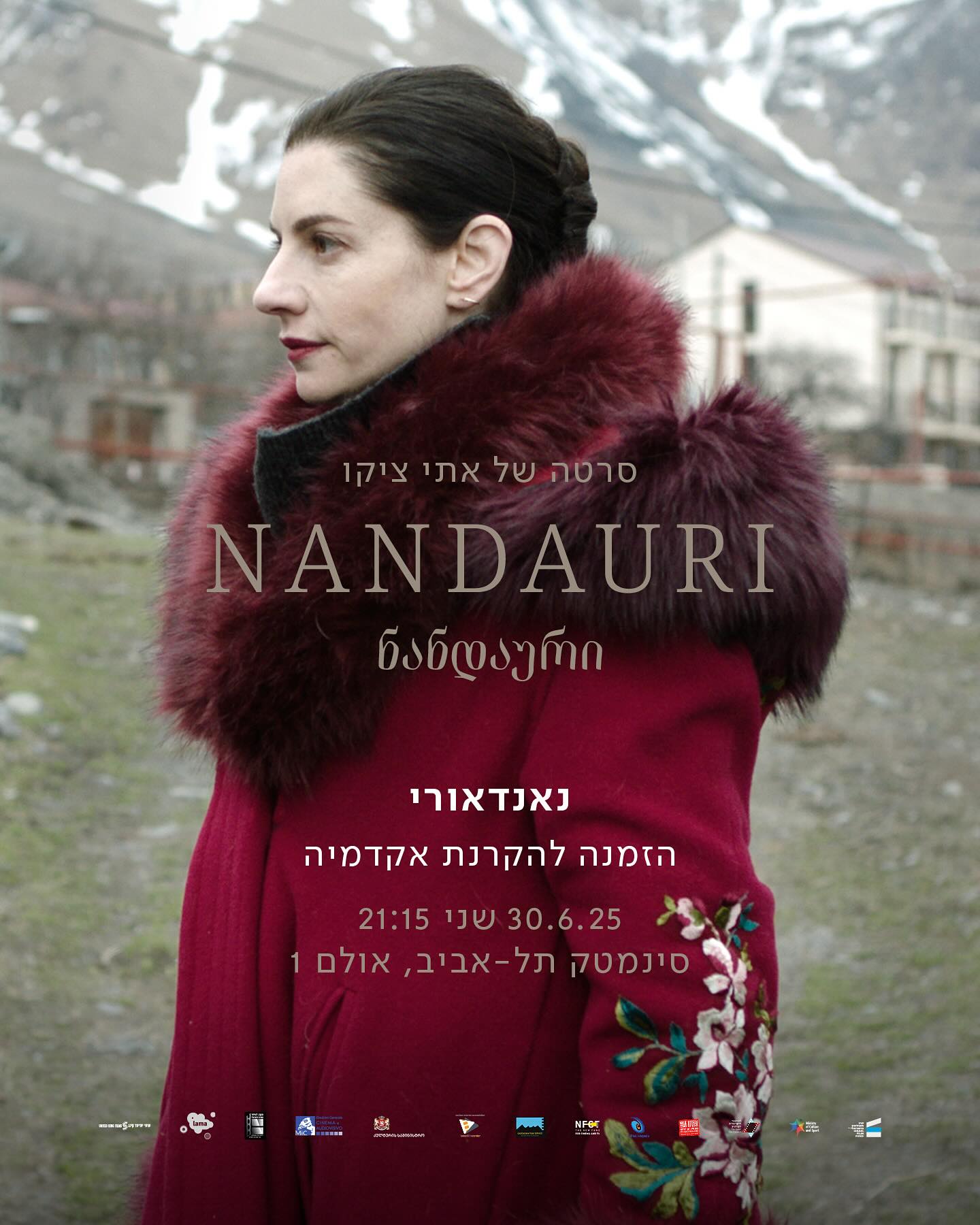
Nandauri — Eti Tsicko
Fiction · 2025 · 1h33 · Horizons Section · With Neta Riskin · Five Ophirs 2025 including Best Director and Best Actress · Best First Film and Best Cinematography, Jerusalem 2025 · Best Film, 26th Festival of Israeli Cinema in Paris
A director signing her own past
Eti Tsicko was born in Ashkelon to parents who had emigrated from Georgia. Her older sister had an arranged marriage. She left home at eighteen. Fifteen years later, she herself wrote the screenplay for this debut feature, shot entirely in Georgia.
Marina, an Israeli lawyer, returns to the country to represent Nino, a mother who left Georgia eleven years earlier abandoning her son, and who now wants him back. In an isolated village in the snowy mountains, she meets Dato, Nino’s brother and the child’s guardian. A society where women marry at sixteen, where silence about violence against women is an institution.
Desire as resistance
The film slowly builds a tension between two beings who initially clash, then end up helping each other. Desire is born in silences, in resistance, in the very impossibility of simple agreement. When it finally breaks through, Tsicko films it as a liberation shot through with loss. The scene burns with intensity.
Neta Riskin, known for her role as Giti in Shtisel, learned Georgian for the role and is present in every scene. Her performance earned her the Ophir for Best Actress. Shai Goldman photographs the two characters in wide, slow shots, inspired by Antonioni according to the director. Marina’s red coat — pomegranate-coloured, made in Georgia — tells us clearly that she is a product of both cultures.
She whom I desire
Filming took place in spring 2023, six months before 7 October. Nandauri comes from elsewhere and from longer ago than the war. And Salomé, aged thirteen, sings Nandauri — “she whom I desire” — in a world where women’s desire is confiscated from childhood.
Oxygen — Netalie Braun
Fiction · 2025 · 1h35 · With Dana Ivgy · Best Israeli Film, Jerusalem 2025
The paper she signed
Anat, a schoolteacher passionate about poetry and a single mother, is waiting for her son Ido’s release from the army. They had planned to go to India together. That day, a soldier is kidnapped on the Lebanese border, a new war breaks out, all leave is cancelled. Anat learns that Ido has volunteered to stay at the front. In Israel, parents of an only son sign a waiver authorising their child to serve in a combat unit. That is the paper Anat signed. That is what she lives with.
The film is set in Haifa, thirty kilometres from the Lebanese border. Sirens are part of everyday life. This context lives in Anat’s body — in the way she cooks to fill the waiting, checks her phone, still sees in Ido the child she carried. The radio plays programmes in which mothers who support the war effort are praised.
Water as visual thread
Water is the film’s visual thread. The sea, the port as a horizon of escape, a windscreen being washed. Braun returns to it each time Anat approaches a limit. Water speaks of motherhood in its most primal sense: the body that contains, protects, holds back. The son moving away towards Lebanon. Braun, whose own son is asthmatic, found in this image something exact: waiting for someone to give you back the air.
Three generations, the same machinery
Anat’s grandfather, a war hero, crawls on the floor because of PTSD. Braun deconstructs the Israeli ethos from its foundation to the present: the hero who collapses, the mother who signs, the son who leaves. Braun developed the screenplay at the Sam Spiegel Lab as early as 2021.
The Lebanon war she was imagining then was underway during filming, and continues still. Dana Ivgy, three-time Ophir winner, saw her hair turn white in two weeks of shooting. She has a brother who is a soldier.
Also read: review of Mama, directed by Or Sinaï
Documentaries
Unraveling UNRWA — Duki Dror
Documentary · 2025 · 1h30 · In partnership with Actions Avocats · Best Investigative Documentary, Haifa 2025 · Best Documentary, 26th Festival of Israeli Cinema in Paris
A temporary structure made permanent
Duki Dror, director of Supernova: The Music Festival Massacre (2023) and Mossad: Israeli Agents Speak (2015), takes on UNRWA: an agency created in 1949 as a temporary structure to manage the Palestinian refugee crisis following the 1948 war, which seventy-five years later continues to operate, perpetuating refugee status from generation to generation. His central question: how did a structure conceived for eighteen months end up at the very heart of the conflict?
7 October 2023 will remain the largest massacre of Jews since the Holocaust. 1,219 people were killed and 251 taken hostage. Among the attackers: UNRWA employees. Six entered Israel, four participated in hostage abductions, others transported weapons. These men worked for a UN agency more than half of whose funding — approximately one billion euros per year — comes from European countries.
The structural anomaly
What distinguishes UNRWA from any other UN organisation is its structural anomaly: it is the only one to transmit refugee status by descent, from generation to generation. Zlatko Zigic, former director of the UN refugee agency for the former Yugoslavia, illustrates this: one million Bosnians driven from their homes between 1992 and 1995 — resettled, disappeared as a category. Korean refugees from the 1950s, resettled in four years with a third of UNRWA’s budget. So how did 600,000 refugees from 1948 become six million? A Palestinian naturalised as a Belgian citizen remains a refugee according to UNRWA. So does his son.
Mohammed Dajani, a Palestinian academic whose family were custodians of the Tomb of David in Jerusalem, embodies a complexity that the grand narrative erases. His presence on screen says something that statistics do not: Palestinian history is plural, and it is precisely this plurality that UNRWA has helped to suppress.
“Who is the wolf? The Jews.”
The most striking sequence is filmed with a hidden camera. In an UNRWA school in Balata, near Nablus, under the United Nations flag, a teacher tells her pupils: “Our families had beaches, homes, villas. And then the wolf arrived. Who is the wolf? The Jews.” European funds finance this lesson. Textbooks rewritten after 2007 erase any mention of coexistence and teach children, from the earliest age, to kill Jews in order to reconquer a land whose history is falsified page after page.
Jonathan’s body in a UNRWA vehicle
Ayelet Samerano learns from surveillance footage that the body of her son Jonathan, killed at the Nova festival, was dragged along the ground and taken to Gaza in a UNRWA vehicle by one of the agency’s social workers. “A worker from a humanitarian organisation kidnapped my son,” she says. The agency dismisses around a dozen implicated employees. European funding, briefly frozen, is quickly restored.
In December 2025, the UN General Assembly renewed UNRWA’s mandate for three years. The United States voted for its abolition. Israel destroyed the agency’s headquarters in East Jerusalem in January 2026. Europe continues to fund it. The agency still exists.
This film poses a question that the campaigning documentary rarely asks with such rigour: after 7 October, after seventy-five years of institutional failure, is peace still possible?
Proud Jewish Boy — Isri Halpern
Animated Documentary · 2025 · 1h27 · Jewish Experience Section · Best Documentary, Haifa 2025 · Best Documentary, 1st Israeli Cinema Prize, Jerusalem, January 2026
An act, a night, an erased history
On 7 November 1938, Herschel Grynszpan, aged seventeen, walked into the German embassy on Rue de Lille in Paris and fired three bullets at embassy secretary Ernst vom Rath. Two days later, vom Rath died. Goebbels seized on the act: more than a thousand synagogues burned, hundreds killed, tens of thousands arrested. Kristallnacht. Grynszpan had been born in Hanover to Polish Jewish parents living in Germany without citizenship. In October 1938, the regime had brutally expelled more than 17,000 Jews of Polish nationality, abandoned at the border in appalling conditions. His parents were among them, in Zbąszyń.
He died several times
The title turns against Nazi propaganda the vocabulary it used to denigrate Grynszpan. The film investigates why this history has been erased — uncomfortable for all sides. Halpern follows post-war legal battles, archive trails, intelligence files. Grynszpan’s fate remains unknown. “He died several times,” Halpern says. “1942, 1943, 1945, depending on who you ask.”
Halpern is director, producer, cinematographer and editor of his own film. The animation is by David Polonsky and Michael Faust.
The Chouchani Enigma — Michael Grynszpan
Documentary · 2024 · 1h25 · Jewish Experience Section · Best Documentary, Israeli Film Critics Union (2023) · Golden Lily Best Documentary and Audience Award, Israeli Film Festival Montreal 2025
A scholar without an identity
Who was M. Chouchani? The figure crossed the twentieth century like a learned shadow: a prodigious scholar, a wanderer, a spiritual mentor to Elie Wiesel and Emmanuel Levinas, whose thinking he profoundly influenced. He died in Montevideo in 1968, without his true identity ever having been established. His real name, his origins, his past: unknown.
Ten years of searching
Michael Grynszpan, a filmmaker born in Paris and based in Tel Aviv, spent ten years making this film — ten years of travel, unearthed manuscripts, testimonies gathered from across the world. What The Chouchani Enigma reveals is as much the quest as its subject: a figure who resists all capture, and a filmmaker who keeps moving forward despite that resistance. The screening was followed by a Q&A with Samuel Blumenfeld, journalist at Le Monde.
Hora — Avi Weissblei
Documentary · 2025 · 1h00 · Presented by Ilan Zaoui, founder of Compagnie Adama
A choreographic utopia
A hundred years after the birth of the Hora, Avi Weissblei traces the history of the Israeli folk dance movement through interviews with choreographers, dancers and witnesses.
The Hora: a Romanian word for a dance that is not Romanian, born from the fusion of the Yemeni step brought by the pioneers, Ashkenazi traditions, and the rounds of the kibbutz. Hand in hand in a closed circle, where each individual disappears into the collective. The Dalia festival, organised by Gurit Kadman from 1944 at the kibbutz of the same name, was its crucible: hundreds of dancers, thousands of spectators, and the great choreographers who shaped the repertoire — Gurit Kadman, Rivka Sturman, Leah Bergstein, Yardena Cohen, Sara Levi-Tanai.
Rabbi Jacob and Louis de Funès
The screening was introduced by Ilan Zaoui, a Franco-Israeli choreographer and founder of Compagnie Adama, known in particular for having composed and personally taught the Hassidic dance choreography in The Mad Adventures of Rabbi Jacob (Gérard Oury, 1973) — ten days of rehearsals in Boulogne-Billancourt, a near-friendship with Louis de Funès, and Gérard Oury as an unrelenting director demanding the scene be done over more than ten times.
What remains of a circle dance?
The film is less nostalgic than it first appears. It asks a simple, beautiful question: what remains of a choreographic utopia in a world that can no longer hold together in a circle?
Classic Section — The Pill — David Perlov
Fiction · 1967/1972 · 1h30 · Classic Section · Screening introduced by Nadav Lapid · Friday 20 March, 17h15
Perlov’s only feature fiction film
The Pill was shot in 1967, its release delayed until 1972 because of financial difficulties and production disputes. It was released on the eve of the Yom Kippur War. It is the first and only feature-length fiction film by Perlov, born in Rio de Janeiro in 1930, raised in Belo Horizonte then São Paulo, who arrived in Paris in 1952 to study painting. There he became assistant to Henri Langlois at the Cinémathèque française, discovered Jean Vigo, and befriended Joris Ivens. He emigrated to Israel in 1958. An established documentary filmmaker since In Jerusalem (1963, bronze medal at Venice), his subsequent proposals were rejected by the ideological bureaucracy. Exhausted by these conflicts, he bought a 16mm camera in 1973 and began the Diary, which would span the Yom Kippur War, Lebanon, and a decade of Israeli history.
An uncategorisable burlesque fable
A major documentary filmmaker in Israel, Perlov made only one feature fiction film. It is easy to understand why this film continues to fascinate: it escapes all the expected categories of Israeli cinema of its time. Written by Nissim Aloni, a central dramatist of Israeli modernity, the film follows Platiel, an obsessional hypochondriac, his brother Getz, a failed singer and seducer, and Hermina, his long-time love — soon swept up in a burlesque fable about a rejuvenating pill. When Getz swallows it by mistake, he grows younger, becomes an idol, and sets off a series of absurd, political and delirious situations.
The film’s freedom
What strikes first is the film’s freedom. Black and white, colour, surrealist flights, reversible deaths, pop energy, psychedelic costumes, mini-skirts, boots, Tel Aviv filmed as a nervous and unstable theatre.
Yossi Banai, towering figure of Israeli theatre and song, known for his renditions of Brel, Brassens, Léo Ferré and Piaf — often translated into Hebrew by Naomi Shemer — carries the film with a singularly melancholy nonchalance. The music, by Yohanan Zarai, is still hummed today. Yaël Perlov says she wants audiences to leave the cinema singing Shir Shel Neurim, the song of youth that closes the film.
A work ahead of its reception
A commercial failure on release — critics were accustomed to Bourekas films and Zionist message pictures — The Pill appears today as a work ahead of its time. Yaël Perlov sums it up: “David was not frustrated by the film’s failure. He mainly had the passion to finish it at any cost. He moved on.” That “moving on” was the Diary, begun the following year. Perlov himself confided that he made this film for his father, an itinerant magician with whom he had grown up in Brazil barely seeing him. The 4K restoration by the Israel Film Archive restores its full power today — a collision between satire, gentle madness and formal freedom.
The screening was introduced by Nadav Lapid, whose mother edited the film. Director of Policeman (2011), The Teacher (2014), Synonyms (Golden Bear, Berlinale 2019), Ahed’s Knee (Jury Prize, Cannes 2021) and Yes (Directors’ Fortnight, Cannes 2025).
Hillel Ben-Zeev Perlov, his grandson, directed the short film Shivtown.
Comedy
Hola! Chau — Yohanan Weller
Fiction · 2025 · 1h25 · Screenplay: Elisa Dor
Marcello, an Argentinian-Israeli filmmaker, lives in a house saturated with presences: his wife, their adult children, a son-in-law, a grandchild, a sharp-tongued mother-in-law. When his father and Argentinian sister, absent for ten years, turn up for three weeks, the fragile balance collapses.
Yohanan Weller could not be present, but left a note in which he quotes Billy Wilder: when he feels miserable, he makes a comedy; when he feels full of energy, a serious film. Hola! Chau is a comedy, and he made it in his darkest hour, inspired by a documentary about his own life. In the film, the grandfather declares: “Family is like a mosquito: it’s irritating, it buzzes, it stings — but it carries the same blood.”
Exile as a wound that reunion reopens
The film plays on the mechanics of vaudeville — open doors, old grudges, forced proximity, stinging lines. But behind the comedy, it is exile that drives the story.
Closing Film
Bella — Jamal Khalaily & Zohar Shachar
Fiction · 2025 · 1h15 · Closing Film · With Elisha Banai (grandson of Yossi Banai, seen in the Perlov film), Hanna Birach, Aseel Farhat · In competition, Jerusalem Film Festival 2025
A dove, two families, a stolen car
Yaki discovers too late that Bella, a curly-feathered dove worth 30,000 dollars, is his sole inheritance. The dove has already been taken to a wedding in the West Bank. Yaki sets off with Bilal, his Palestinian childhood friend, and their wives, to retrieve her before an Emirati buyer snaps her up at a beauty contest in Jerusalem. They will cross checkpoints, ruin a wedding, steal the newlyweds’ car, participate in a family reconciliation ceremony and try to revive an unconscious dove.
An Israeli-Palestinian film co-produced by the Dardennes
Bella is a debut feature jointly directed by an Israeli filmmaker and a Palestinian filmmaker.
Zohar Shachar began writing the screenplay in 2008, when her children attended a bilingual Jewish-Arab school in the Hand in Hand network. Jamal Khalaily, born in Acre, contacted her years later to build the screenplay together. The film is co-produced by Jean-Pierre and Luc Dardenne, double Palme d’Or winners at Cannes, and by Israeli producer Moshe Edery.
Bella is a resolutely optimistic film — and these days, that is a welcome thing.
Short Films
Not My Weekend — Rona Segal
Short Film · 2025 · 18 min · In competition · Best Short Film, 26th Festival of Israeli Cinema in Paris
An evening to herself, a daughter with no babysitter
Sharon, in her forties, divorced, has an evening to herself. A rave. A first love to meet again. Her ex-husband doesn’t show up to look after their daughter. And everything that seemed simple becomes impossible. Rona Segal keeps the suspense alive to the end in this space between the mother she is and the woman she wants to remain. The shadow of the Nova festival of 6 October 2023 looms over the entire film, generating a permanent tension.
Half a Date — Eden Abitbol
Short Film · 2025 · 23 min · In competition
A crossword between two worlds
Tzvi, an ultra-orthodox yeshiva student, goes to the recruitment office to obtain a deferral of his military service. Caught in a bureaucratic tangle that threatens his student status, he meets Carmel, the young soldier handling his file. Alone in the office, they begin solving the newspaper’s daily crossword together.
Eden Abitbol, screenwriter of the series The New Black, films less the encounter than the gap: the brief space in which two worlds with no common language invent one. What matters is less the event than the fleeting possibility of another life.
Shivtown — Hillel Ben-Zeev Perlov
Short Film · 2025 · 25 min · In competition · Mathieu Hoche Prize, Marseille 2025 · Unifrance Shortlist, Cannes 2025
The camera as an instrument of survival
Shivtown is Shivta, an ancient Nabataean site in the Negev Desert, where Hillel Ben-Zeev Perlov did his military service as a photographer. The film documents what he experienced there: institutional brutality, physical harassment, the ordinary violence of an artillery base. Armed with a film camera, he documented his daily life in an attempt to find a glimmer of light.
Three generations of Perlov
What makes Shivtown singular is its place in the family lineage. His grandfather, David Perlov, had also used the camera as an instrument of survival and a way of looking at Israel. The editor and co-producer of the film is Yaël Perlov, David’s daughter, also present for the screening of The Pill.
Listen to the interview with Hillel Ben-Zeev Perlov.
Something Blue — Shani Bergman
Short Film · 2025 · 5 min · In competition
Five minutes underwater
A single woman seeks solitude in a park overrun with couples. She finds herself unwillingly drawn into a surreal underwater wedding ceremony. Five minutes, a social-fantastic register, remarkable economy of means. Short, precise, funny.
Find all our videos on Israeli cinema on the Movie in the Air YouTube channel.