Park Chan-wook
The master of Korean cinema
From the Vengeance Trilogy to Cannes 2026, a profile of a visionary filmmaker who changed how the world looks at Asian cinema.
⏱ 12 min read
📂 Directors
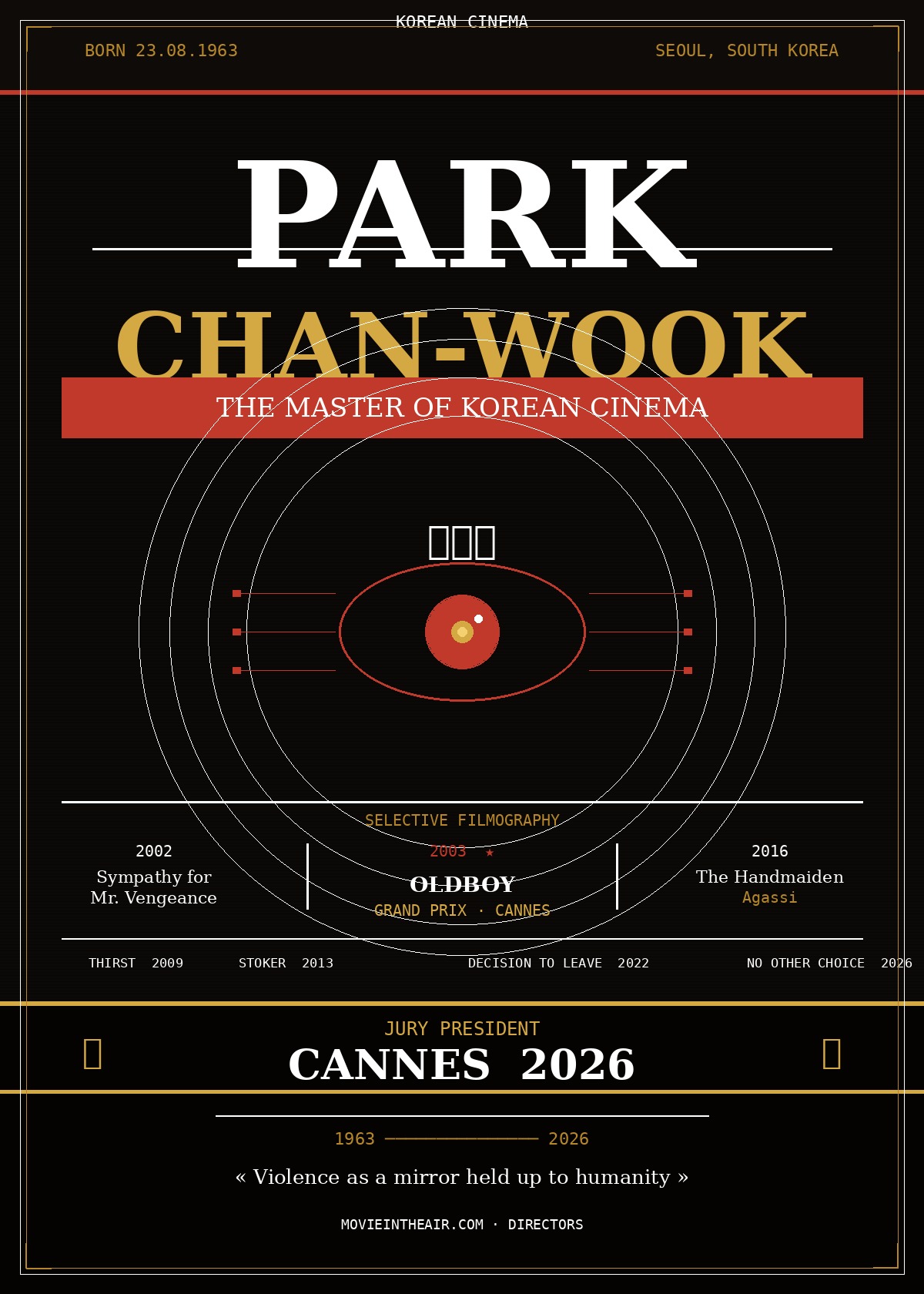
Park Chan-wook is one of the most important and influential filmmakers in contemporary world cinema. Born on August 23, 1963 in Seoul, he has built a rare visual and narrative coherence, blending stylized violence, psychological depth, and a troubling beauty that belongs to him alone.
Early years: a vocation born in cinema
Park Chan-wook discovered his passion for film at Sogang University in Seoul, where he studied philosophy. Watching Alfred Hitchcock’s Vertigo convinced him to devote his life to cinema. He started as a critic before moving behind the camera, directing his first two features to relative indifference: Moon Is… the Sun’s Dream (1992) and Threesome (1997).
It took 2000 and Joint Security Area (JSA) for the Korean public, and soon the international audience, to recognize an extraordinary filmmaker. This political thriller about soldiers from the two Koreas caught in a forbidden friendship became a major hit and, at the time, the most-watched film in Korean cinema history.
The Vengeance Trilogy: a foundational body of work
It was through his celebrated Vengeance Trilogy that Park Chan-wook established himself as a major figure in world auteur cinema. Made up of three standalone films linked by themes rather than characters, the trilogy explores the machinery of revenge, its moral tensions, and its devastating consequences.
A dark, near-documentary opening chapter. A laid-off worker kidnaps his boss’s daughter. The tragic mechanism grinds everyone down, without exception.
A man is imprisoned for fifteen years, then released without explanation and hunts for the truth. Park’s most famous film. The corridor fight scene has become legendary.
A woman leaves prison after an unjust sentence. More lyrical and visually sophisticated than its predecessors.
“Three films, one obsession: revenge as a mirror of humanity.”
Oldboy (2003) won the Jury Grand Prix at Cannes 2004, with Quentin Tarantino as jury president. The corridor fight, staged like a single take, has since entered world cinema legend.
An instantly recognizable visual style
Park doesn’t aim to repel, he aims to confront the viewer with their own contradictions.
What strikes you in Park Chan-wook’s work is first the force of his visual style. Working closely with cinematographer Chung Chung-hoon, he developed a cinematic grammar built on rigorous geometric compositions, intense symbolic palettes, and framing that turns each shot into a tableau.
Violence, ever-present in his cinema, is never gratuitous. It is staged with surgical precision, often tinted with chilling irony or a baroque aesthetic that forces the viewer to examine their own fascination.
Beyond vengeance: range and ambition
Although Park Chan-wook is often associated with violence and dark narratives, his filmography shows remarkable curiosity and versatility.
I’m a Cyborg, But That’s OK (2006)
He surprised everyone with a delirious, colorful romantic comedy set in a psychiatric hospital, a love letter to outsiders and misfits.
His vampire film explores desire, guilt, and Catholic faith through the lens of the fantastic.
The Handmaiden (2016)
Adapted from Sarah Waters’s novel Fingersmith, this erotic-romantic thriller set in colonial Korea in the 1930s may be his most formally accomplished film. Its three-part structure, each part revealing new layers of truth, and its sumptuous cinematography make it a reference work.
International breakthrough
Park Chan-wook’s international ambition took shape with Stoker (2013), his first English-language film, starring Nicole Kidman and Mia Wasikowska. The gothic family thriller seduces with visual sophistication and suffocating tension.
In 2022, he returned to Korea with Decision to Leave (Heojil Kyolshim), a romantic noir inspired by the golden age of Hollywood. Awarded the Best Director Prize at Cannes, it shows a filmmaker renewing himself while remaining unmistakably his own.
No Other Choice: a return to dark comedy
His most recent film, released in France on February 11, 2026 under the title No Other Choice, is another demonstration of his range. Adapted from Donald E. Westlake’s novel The Ax (1997), which Park wanted to bring to the screen for over twenty years, the story is transposed to contemporary South Korea.
You Man-su (Lee Byung-hun), a paper mill executive for twenty-five years, is brutally laid off. To protect his family (Son Ye-jin) and keep his home, he devises a chilling plan: eliminate, one by one, the other candidates likely to take the job he wants. What could have been a straightforward thriller turns into a biting dark comedy, driven by a sharp gaze at Korean capitalist society.
Some have noted thematic echoes with Bong Joon-ho’s Parasite.
An enduring bond with Cannes
The relationship between Park Chan-wook and the Cannes Film Festival is one of the richest bonds Korean cinema has forged with the institution.
| Year | Film | Award |
|---|---|---|
| 2004 | Oldboy | Jury Grand Prix |
| 2009 | Thirst | Jury Prize |
| 2016 | The Handmaiden | In Competition |
| 2022 | Decision to Leave | Best Director Prize |
| 2026 | 79th edition | 🏛 Jury President |
On February 26, 2026, Cannes announced that Park Chan-wook would preside over the jury of its 79th edition (May 12-23, 2026). He became the first Korean director to hold the position, and only the third Asian filmmaker after Tetsurō Furukaki (1962) and Wong Kar-wai (2006).
A major legacy
Park Chan-wook’s influence on world cinema is hard to overstate. His Vengeance Trilogy opened doors, inspired countless filmmakers worldwide, and helped place Korean cinema at the center of international attention, a movement that culminated with Bong Joon-ho’s Palme d’Or for Parasite in 2019.
Complete filmography
In a cinematic landscape often dominated by standardized production, Park Chan-wook’s work stands as a powerful reminder of what cinema can become in the hands of a true artist.
Frequently asked questions about Park Chan-wook
What is Park Chan-wook’s most famous film?
Park Chan-wook’s most famous film is Oldboy (2003), the second installment of his Vengeance Trilogy. It won the Jury Grand Prix at Cannes 2004 with Quentin Tarantino as jury president. The corridor fight staged like a single take is considered one of the greatest scenes in modern cinema.
What is the Vengeance Trilogy?
The Vengeance Trilogy is a set of three standalone films: Sympathy for Mr. Vengeance (2002), Oldboy (2003) and Lady Vengeance (2005). They share no recurring characters, but explore the same moral machinery of revenge and its consequences.
What is Park Chan-wook’s latest film?
His most recent film is No Other Choice, released in France on February 11, 2026. Adapted from Donald E. Westlake’s novel The Ax, it is a dark comedy about unemployment in capitalist South Korea. It premiered in Venice 2025 and received three Golden Globes nominations.
Will Park Chan-wook be at Cannes 2026?
Yes. Park Chan-wook will serve as Jury President of the 79th Cannes Film Festival (May 12-23, 2026). He is the first Korean director and the third Asian filmmaker to hold the position, after Tetsurō Furukaki (1962) and Wong Kar-wai (2006).
Are Park Chan-wook and Bong Joon-ho connected?
Park Chan-wook and Bong Joon-ho are the two leading figures of the “New Korean Cinema.” Their films share a critical gaze on Korean society. The global success of Parasite (Palme d’Or 2019) follows a path that Park helped open internationally from Cannes 2004 with Oldboy.
Film critic passionate about Asian cinema, auteur thrillers, and festival films.