Claude Lanzmann: The Unreleased Recordings of Shoah
The Audio Archive as an Act of Memory
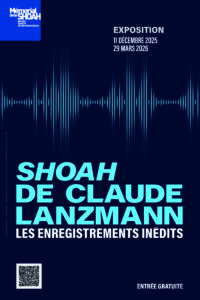
On December 10, 2025, I attended the opening of the exhibition “Shoah by Claude Lanzmann: The Unreleased Recordings.” Since its opening at the Shoah Memorial in Paris, this collection of rare power has resonated with a tragically universal echo.
While we thought these archives were confined to history, the events of mid-December thrust us back into a chilling reality.
The antisemitic terrorist attack at Bondi Beach in Sydney on December 14, where 15 people, including Frenchman Dan Elkayam, were murdered during Hanukkah, is but an alarm signal of a global conflagration.
From the “Jew hunt” orchestrated in the streets of Amsterdam by mobile groups to the systematic harassment of Jewish neighborhoods in Toronto and Montreal, and targeted assaults in New York, Claude Lanzmann’s work is no longer just an object of study: it has once again become a weapon of intellectual defense against a hatred that is once again displayed without shame.
Dominique Lanzmann: Guardian of the “Memory of the World”
None of this journey would be accessible without Dominique Lanzmann. Present at the opening, she leads the Claude and Félix Lanzmann Association with unfailing determination. It was she who championed the joint French-German candidacy that led to the film and its archives being inscribed on UNESCO’s “Memory of the World” register in 2023.
Through her historic donation of 95 original cassettes to the Memorial (a collection to be fully digitized and transcribed by 2027), she transforms what was a private archive into a public good. Her commitment ensures that the passing of the torch between the filmmaker and future generations is not merely a commemoration, but an active antidote to the violence of the present.
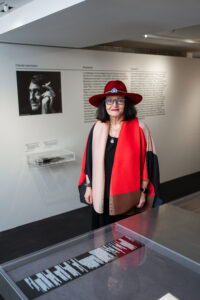
© Shoah Memorial / photo: Yonathan Kellerman. Inauguration of “Shoah” by Claude Lanzmann, the unreleased recordings with Dominique Lanzmann. Shoah Memorial, December 10, 2025
The Hunt: From Research to the Final Project (1973-1985)
Before becoming a 9.5-hour film, Shoah was a titanic investigation spanning twelve years.
Claude Lanzmann, far from being a mere documentarian, turned into an obsessive investigator. Supported by his assistants Corinna Coulmas and Irena Steinfeldt-Levy—integral participants in the process that the exhibition highlights—he traveled across Europe and Israel to collect 220 hours of audio recordings in eight languages.
The film was commissioned by the State of Israel. And the materiality of this work is tangible here: punch cards, systematic research plans, work conducted day and night. The archives also reveal a man more intimate than his myth: we hear his doubts, his raw emotion before the objects in the Auschwitz museum, but also an unexpected camaraderie and humor with his team, far from the image of the solitary filmmaker.
Raoul Hilberg: The Architecture of Proof
The exhibition highlights the central role of Raoul Hilberg. In the unreleased tapes, we hear the dialogue between the filmmaker and the historian. Hilberg provided Lanzmann with the “reading grid”: do not seek the “why” (unsolvable), but the “how.” It was this administrative and bureaucratic approach to the crime that allowed Lanzmann to trap the perpetrators and ask the right questions to the survivors. Hilberg is the intellectual foundation upon which the entire rigor of the film rests.
Secrets of the Edit: The Enigma of the East
A preparatory document lifts the veil on an enigma: the absence of the Einsatzgruppen mass shootings. Lanzmann wanted to cover them, but the impossibility of obtaining filming permits behind the Iron Curtain (Ukraine, Soviet Lithuania) forced him to refocus his work on the mechanics of the extermination centers. This constraint ultimately forged the film’s unique structure, centered on topography and bare speech.
-
Topography: Lanzmann refused the photos of corpses that saturate the gaze. He filmed the locations in the present (tracks, forests, clearings) to transform geography into evidence. If the place is there, the crime is undeniable.
-
Bare Speech: This is testimony without artifice, without music or voice-over. Speech is not a distant narrative; it becomes a present action, captured in its hesitations and silences. Lanzmann establishes facts through space and through the voice.
The Gift of Voices: A Heritage in Progress
The exhibition is based on a major donation: the Claude and Félix Lanzmann Association has given the Memorial a collection of 95 original audio cassettes, recorded during the pre-production phase (1977-1978). This material, whose digitization and transcription (complex due to accents and mixed languages) will be completed in 2027, is not just a supplement. It provides access to the “pre-film”: what was attempted, abandoned, or moved.
We encounter historians like Raoul Hilberg and hear speech being negotiated or clashing with silence. Historian Yitzhak Arad confides his inability to speak about the ghetto. It is also here that Ilana Safran questions Lanzmann about his motivation. His response rings out like an ethic: if the witnesses remain silent, “in 20 years… the whole of history will become completely false. People will say it never existed.”
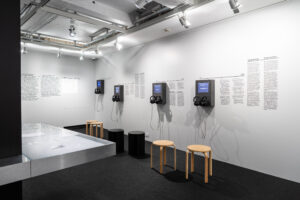
© Shoah Memorial / photo: Yonathan Kellerman. Inauguration of “Shoah” by Claude Lanzmann, the unreleased recordings with Dominique Lanzmann. Shoah Memorial, December 10, 2025
Inaudible Voices
Going up to the third floor is like entering an echo chamber where speech is torn from the void. What we hear in the headphones is the electric material of pre-production (1977-1978):
Ilana Safran: The Sobibor survivor challenges Lanzmann: “Why dig all this up? What’s the point?”. Lanzmann replies: “If we don’t do it, in twenty years, no one will know anything. All history will become completely false. People will say it never existed.”
Dr. Wulf Pessachowitz: He describes the forced abortions in the Šiauliai ghetto. His voice is monotonic, without a tremor. He says: “Abortion was part of the liquidation of the Jewish people.” We hear the surgical description of a crime turned into a simple medical procedure.
Sara Gol: We hear her singing in Yiddish about the massacres in the Ponary forest. This is not music; it is her mother tongue testifying to what they tried to annihilate. The sound of her voice is physical proof that a culture survived.
Yitzhak Arad: The archive records the historian stopping. He says: “I have no words to describe day-to-day life in the ghetto.” We hear the speech falter; silence becomes the very fabric of the trauma.
The Ruse of “Dr. Sorel”
To wrench confessions from former Nazis, Claude Lanzmann invents an alter ego: Dr. Claude Sorel, a French historian allegedly sympathetic to former soldiers.
Armed with fake business cards, he gains the trust of his targets by adopting their bureaucratic vocabulary.
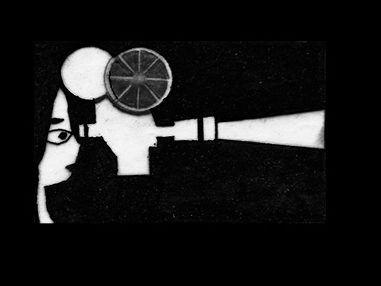
To capture these exchanges, he uses the “paluche”, a miniature camera hidden in a bag or under a coat. A wire connected to a van parked nearby allowed his team to monitor the signal and record the audio live.
The ruse often ends in violence or flight. When the witnesses realize they have been trapped—either because they spot a wire or because Lanzmann’s questions become too precise. Claude Lanzmann was physically assaulted several times during these clandestine interviews (notably by Heinz Reinefarth). These sequences, often blurry and unstable due to the hidden camera, give the film the tension of a thriller. We are no longer in memory; we are in the capture of a confession.
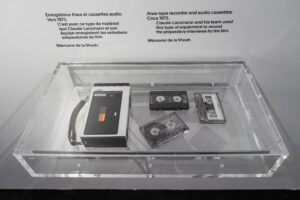
© Shoah Memorial / photo: Yonathan Kellerman. Inauguration of “Shoah” by Claude Lanzmann, the unreleased recordings with Dominique Lanzmann. Shoah Memorial, December 10, 2025
Transmission and Centenary
Lanzmann’s centenary is included in the France Mémoire calendar.
The exhibition is part of an international circuit, being presented in parallel in Berlin (Die Aufzeichnungen), treating this corpus as a common European heritage.
-
On Screen: Guillaume Ribot’s documentary, “I Had Nothing but the Void – Shoah by Lanzmann” (currently on Arte.tv), dives into this epic production using rushes and The Patagonian Hare.
- In the Classroom: Under the direction of historian Jean-François Forges, a booklet now accompanies six 30-minute excerpts specifically selected for students. This program has already been tested at the Institut de France before 300 high school students, proving that the words of witnesses remain the best shield against forgetting. This educational material will be distributed worldwide by UNESCO to teach the history of the Shoah.
Maieutics Against Silence
Going up to the third floor of the Memorial is to realize that speech is a struggle. It is torn from silence, negotiated, stolen, or refused.
Claude Lanzmann does not just film memories; he records a brutal maieutic because “to testify is to relive.” At a time when the last witnesses are passing away, these audio tapes prove that memory does not wear out if the archive is rigorous.
Listening to these voices is a refusal to let silence take hold again.
Practical Information:
-
Dates: Until March 29, 2026.
-
Event: Meeting “Shoah before Shoah: Behind the scenes of the film’s production” with the assistants on Sunday, January 18.
-
To Watch: The documentary I Had Nothing but the Void on Arte.tv. Guillaume Ribot’s film, “I Had Nothing but the Void – Shoah by Lanzmann” documents the making of the work. Using rushes and unreleased interviews, it retraces Lanzmann’s obsession: finding a cinematographic form for a history without images. The documentary shows how the filmmaker built his method, between hunting for witnesses and exhausting location scouting, to transform oral narrative into visual evidence of extermination.